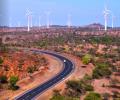
Road awards were muted in Q1FY25. But the pace will accelerate with a bidding pipeline of Rs 1.1 trillion (September 2024), mostly dominated by HAM (Hybrid Annuity Model) projects, which contribute 47 per cent and engineering procurement and construction or EPC projects, which have about 36 per cent share. Hence, infrastructure companies mostly reported revenue decline on a year-on-year (Y-o-Y) basis in Q1FY25.
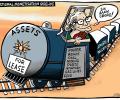
'This will have a multiplier effect in generating more jobs.'

According to reports, public transport and banking services remain partly disrupted for the second day in some states.

Prime Minister Narendra Modi began his engagements in the US on Thursday by meeting with leading American CEOs from five different key sectors and highlighted the economic opportunities in India.

The Centre will release Rs 95,082 crore as tax devolution to the states this month after including one advance instalment to help them push their capital expenditure, Finance Minister Nirmala Sitharaman said on Monday. After a meeting with all chief ministers and state finance ministers, Sitharaman said states had said that it would be helpful for them if the tax devolution is front loaded.

Gandhi said that the BJP government has clearly mishandled the economy that was built by the United Progressive Alliance government, and is now resorting to selling the country's assets as a "last resort" to generate some money.

These are the highlights of the Union Budget 2025-26 presented by Finance Minister Nirmala Sitharaman in Parliament on Saturday.

The strike notices were given by workers' unions of various sectors such as coal, steel, oil, telecom, postal, income tax, copper, banks and insurance.

A joint forum of central trade unions has given a call for a nationwide strike on March 28 and 29 to protest against the government policies affecting workers, farmers, and people.

Infrastructure funds, which bet on stocks closely linked with infrastructure development in the country, have emerged as one of the best-performing categories over the past year. They have generated an average return of 90.63 per cent - the third-best, after technology funds and small-cap funds. Of the 21 schemes in the category, seven have given a return of more than 100 per cent in a year.

"If you show us (threaten us with) ED, we will also send proof against BJP leaders to the agency. A section of BJP ministers and leaders is hand in glove with the coal mafia. They even stayed at hotels run by them during elections," she said.

Prime Minister Narendra Modi on Wednesday said the government has no business to be in business and his administration is committed to privatising all PSUs barring the bare minimum in four strategic sectors. "It is government's duty to support enterprises and businesses. But it is not essential that it should own and run enterprises," he said. Modi also said the Centre's policy is to either monetise or modernise public sector enterprises, with the intent that the government has "no business to be in business".

While activity in the highway segment has been slow, the bid pipeline saw recovery in January 2024, and awards are expected to improve in Q4FY24. The national highway (NH) bid pipeline has recovered from a low of Rs 15,900 crore in December 2023 to Rs 68,400 crore at present. The NHAI's pipeline stands at Rs 66,100 crore, with hybrid annuity model (HAM), build operate transfer (BOT) and engineering procurement and construction (EPC) projects accounting for 60 per cent, 29 per cent and 13 per cent share, respectively.

Finance Minister Nirmala Sitharaman on Monday presented the Budget for 2021-22 in the Lok Sabha that is expected to provide relief to the pandemic-hit common man as well as focus more on driving economic recovery through higher spending on healthcare, infrastructure and defence amid rising tensions with neighbours, As India emerges from the COVID-19 crisis, the ninth Budget under the Modi government, including an interim one, is widely expected to focus on boosting spending on job creation and rural development, generous allocations for development schemes, putting more money in the hands of the average taxpayer and easing rules to attract foreign investments.

Industry experts believe that this deal will positively impact the Indian film industry, which is struggling with fewer movie releases.

Finance Minister Nirmala Sitharaman on Tuesday said monetisation of Central Public Sector Enterprises (CPSE) assets is based on the principle of value creation for the government and investors and would bring about a paradigm shift in infrastructure augmentation and maintenance. Chairing the National Workshop with the states/UTs on Asset Monetisation organised by Niti Aayog, the minister sought the collaboration of states for the holistic development of infrastructure. She said India can become a $5 trillion economy, while striking the right balance between fiscal imperatives and socio-economic welfare, through active collaboration between the public and private sector.

Referring to Modi, Adityanath and Union Home Minister Amit Shah as 'outsiders', the farmer leader said he has no objection if they become prime ministers after winning polls from Uttarakhand or Gujarat.

Expect a more modest out-turn of around 5 per cent (if not less) because of the longer-term scarring effects of the Covid shock, the sharply slowing growth in the pre-Covid years and some scepticism about the growth-efficacy of some of recent official policy initiatives, explains Shankar Acharya, former chief economic advisor to the government.

A 25 per cent year-on-year (Y-o-Y) increase in budget allocation towards the roads sector for FY24 has led to renewed interest among investors. However, a combination of escalating costs for Bharatmala and unseasonal rains to some extent have impacted progress. Bharatmala's cost has nearly doubled from Rs 5.35 trillion to Rs 10.6 trillion and the finance ministry has asked MoRTH to go slow until Cabinet approval is received.

There's a straightforward relationship between economic activity and power consumption. If economic activity increases, so does power consumption. Since the latest GDP (gross domestic product) data indicates India's growth rates exceeded expectations in the second half if the 2022-23 financial year (H2FY23) and GDP estimates of FY24 are strong, we would expect power consumption to rise as indeed it has. There is also a direct relationship between power consumption and National Thermal Power Corporation or NTPC's results since the public sector undertaking (PSU) is the largest power generator in India.

The challenges before the coming Budget are more daunting than those in 2021, reveals A K Bhattacharya.

Ailing telecom operator Vodafone Idea has flagged the industry's "unsustainable financial duress" in its latest annual report and hoped that the government would provide the necessary support to address "all structural issues" faced by the sector. In the chairman's letter to shareholders, Himanshu Kapania cited persistent challenges in the operating environment, amid "unsustainable pricing" and "hyper-competition" during FY21. Kapania expressed hope that government will support efforts to generate reasonable returns on massive investments.
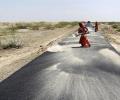
Accelerated development of highways will be taken up with 2,500 km access controlled highways and 9,000 km of economic corridor. In addition, there will be 2,000 km each of strategic highway projects and port connectivity projects, she said.
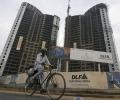
Encouraging results for the fourth quarter of the 2022-23 financial year (Q4FY23) have led to a big surge in the share price of DLF. The realty major closed FY23 with Rs 15,000 crore (up 107 per cent year-on-year or YoY) of pre-sales, leading to cash generation of Rs 2,500 crore (up 14 per cent YoY) and reduced net debt by Rs 1,960 crore YoY. The launch of The Arbour project in Q4FY23 alone drove sales of Rs 8,000 crore in the quarter.

The regulator is more carefully scrutinising applications by infrastructure investment vehicles that have a limited number of investors. They have been asked to broaden their investor base before application approval, according to two people familiar with the matter. The Securities and Exchange Board of India is concerned about the structure being used for getting around tax requirements, according to one of the sources.

Expressing commitment to augment the country's infrastructure, Finance Minister Nirmala Sitharaman on Monday proposed to significantly enhance capital expenditure to Rs 5.54 lakh crore in the next fiscal, besides creating institutional structures and giving a big thrust to monetizing assets to achieve the goals of the National Infrastructure Pipeline (NIP). Sitharaman said NIP, that was launched in December 2019 with 6,835 projects, has now been expanded to 7,400 projects and around 217 projects worth Rs 1.10 lakh crore under some key infrastructure ministries have been completed. "For 2021-22, I propose a sharp increase in capital expenditure and thus have provided Rs 5.54 lakh crores which is 34.5% more than the BE of 2020-21," the finance minister said.

Finance Minister Nirmala Sitharaman had in May announced that there will be a maximum of four public sector companies in strategic sectors, and state-owned firms in other segments will eventually be privatised.

The infrastructure spending target for 2020-25 was revised because of additional and amended data provided by central ministries, state governments since the release of the summary NIP Report in December 2019 when it was pegged at Rs 100 trillion.

The divestment target remaining unchanged, from the 2019-20 interim Budget, this year means the Centre will now have to depend on non-tax revenue sources like dividends from the RBI, PSBs and PSUs, as there are real concerns of a tax revenue shortfall. The fiscal deficit target of 3.4% of GDP for 2019-20 is likely to be retained as well.

While most experts suggest the government loosen its purse strings and not worry about the fiscal deficit in a pandemic impacted year, it will be a tightrope walk for the government to increase spending without going overboard.
But it is disappointing to note that Sitharaman's third Union Budget continues to promote a few problematic ideas, observes A K Bhattacharya.

The Budget emphasises on capacity building and empowerment of marginalised sections of society including farmers.

The US has the distinction of destroying a flawed but functioning State thrice since 1979. Pakistan has been their constant accomplice, explains Shekhar Gupta.
Long-term funding was a requirement for infrastructure projects, and asset-liability mismatch in the banking system, impacts the access to finance for infrastructure projects. One of the key challenges would, however, be to get private sector back into investing.

To redevelop cities as 'smart', investment of at least $10 billion is required. For 100 cities, it works out to $1 trillion

Money is being released and the government knows it will have to front-run private investment.
